





Why the midmarket is finance AI’s next tipping point

Growth has a way of exposing the cracks in your finance processes.
As organizations expand, more employees are spending company money, which means more transactions to code and reconcile and more information moving between systems.
A reconciliation process that worked when transaction volume was lower can quickly become a bottleneck. Eventually, finance reaches a point where the processes that got you this far can’t absorb much more growth without creating more work.
PEX’s State of Finance 2026 report shows just how quickly that work can accumulate. The manual workload becomes more pronounced as organizations grow. Among organizations with $10 million to $50 million in revenue, 31% spend more than 20 hours a month on receipts, coding and reconciliation. At $50 million to $250 million, that rises to 48%.
That may be the real tipping point for AI in finance. It’s not about crossing a particular revenue threshold. It’s about reaching the point where manual processes become increasingly difficult to scale without adding more manual work.
For midmarket organizations, those with $10 million to $250 million in annual revenue, this is also an opportunity. Growing finance teams can build for that complexity now, using AI and automation to create capacity, strengthen control and scale finance alongside the business.
What happens when finance hits the scaling wall?
The first signs that finance is struggling to keep up with growth can be easy to dismiss. Close takes a little longer, reconciliation requires more cleanup and another approval gets added to the process. Before long, teams are leaning more heavily on spreadsheets to keep track of what’s happening.
But those small inefficiencies compound as transaction volume grows. PEX’s research found that the share of organizations taking six or more business days to close jumps from 31% below $10 million in annual revenue to 49% at $10 million to $50 million, compared with 39% of all respondents.
Controls can also become harder to maintain as more people spend company money. Among organizations with $10 million to $50 million in revenue, only 16% enforce spending policies at the point of transaction, while 43% catch issues after the money has already been spent. At the same time, 58% of all finance leaders say they want real-time spend controls they don’t have today. That gives growing companies an opportunity to put more proactive controls in place before complexity increases further.
The instinct may be to solve the capacity problem by adding people. But a growing workload doesn’t necessarily mean finance needs more hands doing the same work. It may be a sign that the processes themselves need to change.
How AI can help finance absorb growth
AI doesn’t have to take over entire finance processes to create more capacity. Its value can come from reducing the repetitive work embedded in those processes.
More transactions to process
Every additional transaction can create another receipt to collect, expense to code and purchase to reconcile. AI can reduce how much attention each one requires from finance.
For example, AI can match receipts to transactions instead of leaving finance to pair documentation manually. It can also suggest transaction coding for a person to review rather than requiring every expense to be coded from scratch. That addresses a significant source of friction: 30% of respondents to PEX’s State of Finance 2026 survey named receipts and reconciliation as their biggest finance operations challenge.
More exceptions to review
As transaction volume and distributed spending grow, reviewing everything manually becomes harder to sustain. AI can help separate routine activity from transactions that need a closer look, allowing finance to spend more of its time on exceptions and decisions that require judgment.
That doesn’t mean removing people from the process. It means using AI to handle or assist with repetitive steps while keeping human review where context, judgment and accountability are critical.
More information to reconcile
Growth also means more receipts, coding information and transaction data have to make their way into finance systems accurately. Capturing documentation and coding information closer to the point of spend can reduce the amount of cleanup waiting for finance at month-end.
AI can assist with the capture, matching and categorization of that information, while connected systems can move completed transaction data into the accounting platform without another round of manual entry.
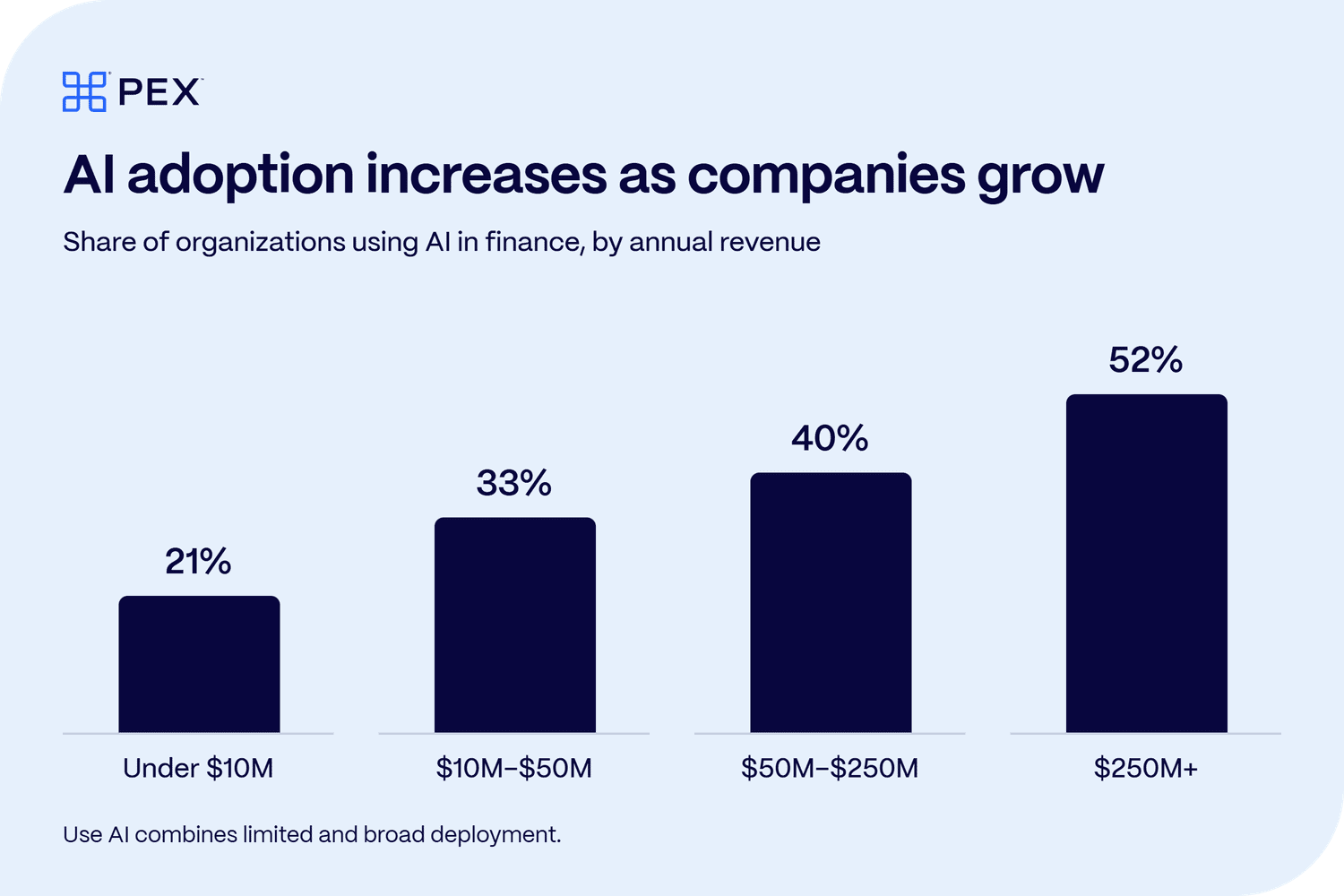
As these pressures increase, more finance teams are putting AI to work. AI usage climbs from 33% of organizations with $10 million to $50 million in revenue to 40% at $50 million to $250 million and 52% at $250 million and above.
PEX’s research also suggests the payoff grows as teams put AI into practice. Reported ROI rises from 3% among teams that haven’t started with AI to 25% among those experimenting or in early adoption and 59% among teams scaling it. The share reporting a shorter close rises from 5% to 42% to 82%. Midmarket teams are sitting at an important point in that progression. Only 9% of organizations with $10 million to $50 million in revenue and 12% at $50 million to $250 million have reached the scaling stage, so most midmarket teams still have that payoff ahead of them.
A 90-day plan for taking pressure off finance
You don’t need to overhaul every finance process at once. Start with one process that has become harder to manage as the organization has grown and use the next 90 days to redesign and test that workflow.
Days 1–30: Find where growth is creating the most work
Look for the tasks that have become more time-consuming. That might be reconciling transactions, coding expenses, chasing down documentation or reviewing exceptions after the fact.
Establish a baseline before changing anything:
- How much time does the process take?
- How many transactions require manual intervention?
- How many exceptions does finance handle?
- If the process affects close, how much time does it add?
Then choose one process where reducing repetitive work would create meaningful capacity for the team.
Days 31–60: Redesign the process around AI
Don’t simply add an AI capability to an existing manual process. Look at the workflow from beginning to end and identify where AI could eliminate or reduce repetitive steps:
- What information could be captured earlier?
- Which routine tasks could AI handle or assist with?
- Where is human review still required?
Then put the redesigned process into day-to-day use and pay attention to the exceptions. Those can show you where the workflow or its guardrails need adjustment.
Days 61–90: Measure whether the process can absorb more work
Go back to the baseline you established during the first month. Look at the differences between where you started and where you are today:
- How much has manual processing time decreased?
- Are fewer transactions requiring intervention?
- How much has reconciliation work decreased?
- Has the process helped shorten close? If so, how much?
The most important measure isn’t how much AI you’re using. It’s whether finance can handle more activity without a corresponding increase in manual effort.
If the answer is yes, look for the next process where growth is creating disproportionate work and apply what you learned there.
How PEX helps finance teams scale with AI
PEX can help finance teams use AI where increasing transaction volume and organizational complexity create more work, while keeping people involved where judgment is required.
- Spend less time processing each transaction. PEX uses AI to match receipts and invoices with transactions and suggest GL codes. Instead of requiring finance to handle every step from scratch, AI can take on repetitive processing while cardholders and administrators review information when needed.
- Keep exceptions from getting lost in higher transaction volume. As more transactions move through the system, finance needs to know which ones require attention. PEX can take repetitive work out of routine transaction processing, leaving finance more time to investigate missing information, unusual expenses and other exceptions that require human review.
- Reduce the administrative burden of a larger organization. Growth doesn’t just create more transactions. It can also mean more cards, spend rules, permissions and account changes to manage. The PEX agent lets admins ask questions and complete account-management actions from a prompt, including creating spend rules and carrying out multiple actions from a single request.
What scaling with AI looks like at Cypressbrook
Cypressbrook Multifamily Management oversees 11 properties, each with its own account. Reconciliation required the company’s accountant to read property managers’ notes, determine what each expense was for and re-enter GL codes into an upload template.
With PEX, managers use AI-powered suggestions to assign GL codes and add notes directly to transactions during reconciliation. When accounting exports the reconciliation report, the coding is already structured in the file, eliminating the need to interpret notes and re-enter codes manually. Combined with structured exports, the new process saves five hours per month on reconciliation.
Build for the next stage of growth
The processes that work today won’t necessarily be the ones that carry finance through its next stage of growth. The goal is to make sure increasing transaction volume doesn’t automatically mean increasing the amount of work your team has to do.
AI can help keep that growth from translating directly into more work for finance. Used in the right places, it can take repetitive work out of everyday processes while leaving people focused on the exceptions and decisions that need their judgment.
For midmarket finance teams, the opportunity is to use AI and automation to create more capacity without sacrificing visibility or control. Teams that build for that now will be better positioned to scale finance alongside the business.
PEX’s State of Finance 2026 report looks at how finance teams are using AI today, where adoption is accelerating and where the biggest opportunities remain. Explore the full report to see how your organization compares.



Opinions, advice, services, or other information or content expressed or contributed here by customers, users, or others, are those of the respective author(s) or contributor(s) and do not necessarily state or reflect those of The Bancorp Bank, N.A. (“Bank”). Bank is not responsible for the accuracy of any content provided by author(s) or contributor(s).