





AI adoption in finance: What 687 finance leaders told us about the state of AI in 2026
PEX’s 2026 State of Finance report surveyed 687 finance and operations leaders and found a clear gap between AI interest and execution. Interest reaches 66% for audit documentation automation, yet only 31% currently use AI in finance and just 9% use it broadly. Trust in AI accuracy is the leading barrier across every revenue band and industry cluster surveyed. Finance wants more from AI. But more automation cannot mean less control.
- 66% are interested in audit documentation automation, the highest-demand capability in the report
- 31% currently use AI in finance and only 9% use it broadly
- 67% automate no more than 20% of their transactions
- 36% name trust in AI accuracy as their biggest adoption barrier
- Only 28% are comfortable allowing AI to make routine financial decisions
- Just 18% enforce spend policy at the point of transaction
Middle-market organizations ($10M–$250M) report the longest month-end closes and fastest-growing finance teams in the survey, while automating transactions at nearly the same low rate as companies under $10 million.
The execution gap takes a different shape across each industry cluster:
- Professional and managerial organizations lead adoption: 48% currently use AI and 32% report measurable or believed ROI
- Construction and industrial organizations favor hard controls: 25% enforce policy at the point of transaction, but only 27% currently use AI
- Nonprofits show strong interest but limited execution: 69% are interested in audit documentation automation and 70% in cash-flow forecasting, while only 23% currently use AI
- Media and entertainment organizations are exploring but rarely deploying broadly: 26% are piloting AI, while just 5% use it broadly. These findings are directional because this was the smallest industry cluster, with 61 respondents
Teams further along report substantially stronger results. Those who have successfully implemented AI, or “run stage” teams, 59% report ROI, 82% report less manual review and 82% report shorter close times.
Finance teams want more from AI, particularly for audit documentation, forecasting, fraud detection and transaction categorization. Progress depends on applying AI to defined workflows, keeping appropriate oversight in place and measuring the results.
The report shows where finance teams stand today and how to assess whether your organization is ahead of the pack, on pace or still at the starting line.
Finance wants more from AI. So why are most teams still at the starting line?
Finance leaders already see where AI and automation could help. The survey asked respondents whether they currently use, are interested in but not yet using or are not interested in seven specific capabilities. Across every capability tested, more than half expressed interest, ranging from 53% to 66%. Current usage, however, ranged from just 11% to 27%. The gap shows that demand is already established. The challenge is turning it into practical adoption. Interest was highest for:
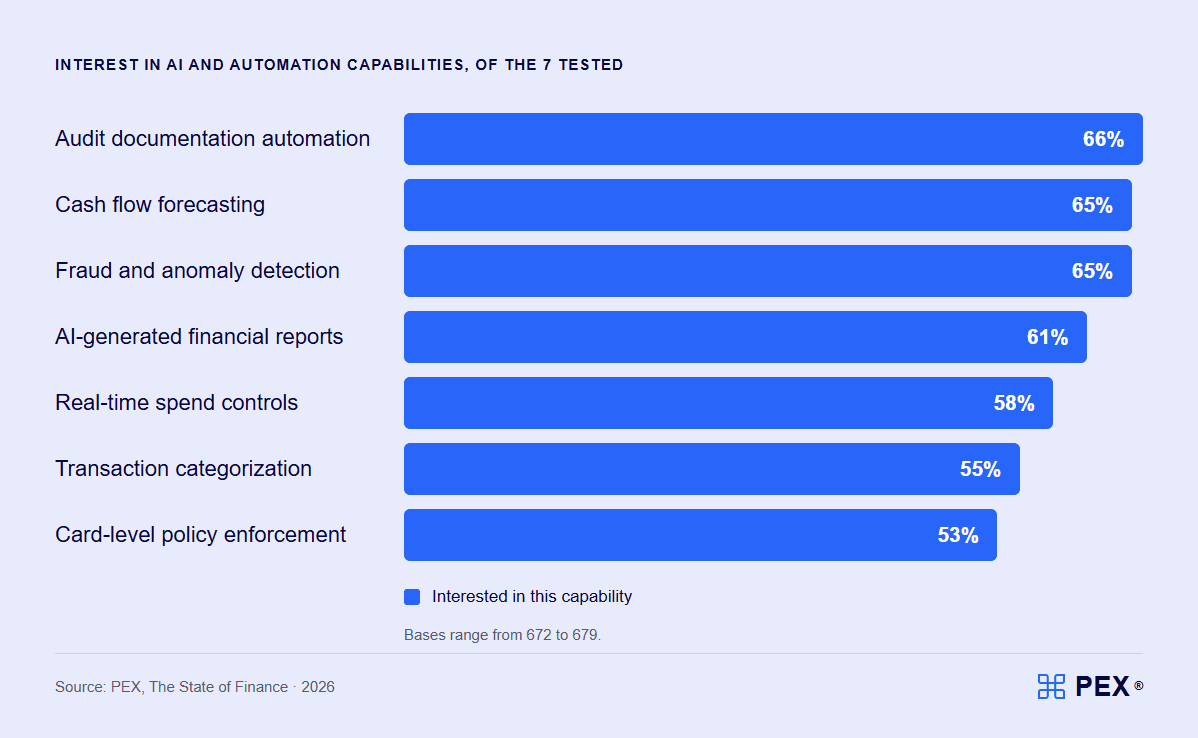
These are practical finance priorities. Teams want to spend less time gathering audit documentation, categorizing transactions and reviewing routine activity. They also want earlier visibility into cash flow, fraud and out-of-policy spending. Current usage remains far lower. Audit documentation automation is used by 15% of respondents. Cash flow forecasting is used by 11% and AI-generated financial reports by 14%. Overall, only 31% currently use AI in finance. Just 9% use it broadly across the function.
Where does AI adoption in finance stand today?
The survey reveals four distinct levels of adoption:
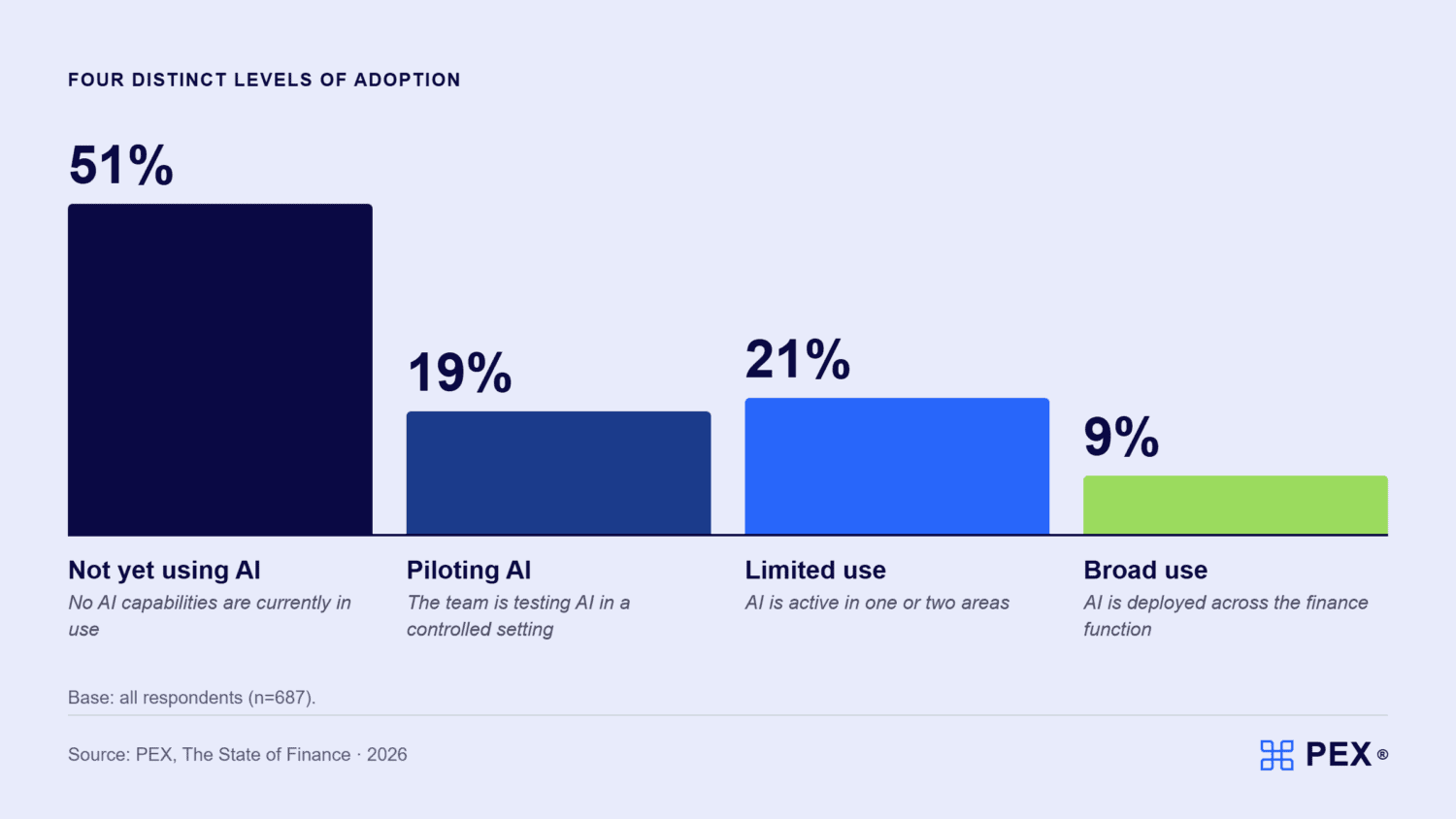
Seventy percent of finance teams have either yet to begin or are still piloting AI. Another 21% use it in only one or two areas. Limited adoption often takes the form of one contained capability. A team may use AI to categorize transactions, detect anomalies or create a first draft of a financial report. Broad deployment connects several capabilities across everyday finance operations. Testing a tool can reveal whether it works. Operational adoption requires clear ownership, connected systems, review processes and a way to measure the outcome.
The execution gap crosses industries and company sizes
Larger organizations have generally moved further with AI, but adoption remains incomplete at every level.
AI usage rises from 21% among organizations with less than $10 million in annual revenue to 33% among companies with $10 million to $50 million. It reaches 40% among companies with $50 million to $250 million and 52% among organizations above $250 million.
Even in the most mature revenue band, almost half of organizations do not currently use AI in finance.
The same pattern appears across industries:
- Professional and managerial organizations lead adoption at 48%.
- Construction and industrial organizations report 27% adoption.
- Nonprofits report 23% adoption.
- Media and entertainment organizations report 23% adoption.
Each industry faces different operational pressures. Construction and industrial teams manage distributed field spending. Nonprofits carry significant documentation and accountability requirements with limited resources. Media and entertainment teams handle project-based spending and changing production needs. Professional and managerial organizations are further along, but still face questions around scale and ROI.
Zoom in on the middle market and the gap turns into a genuine squeeze. These teams report the longest month-end closes in the survey: 48% take six or more business days to close, compared with 31% of organizations under $10 million and 39% of those above $250 million. Their finance teams are also growing the fastest, with 40% adding headcount in the past two years, versus 26% at smaller organizations and just 24% at the largest.
That growth is outpacing their tooling. 36% of middle-market teams spend more than 20 hours a month on manual receipt collection, coding and reconciliation. That’s nearly double the share at companies under $10 million. Yet 68% still automate no more than 20% of their transactions, compared with 70% of organizations below $10 million and 59% of those above $250 million. Middle-market finance teams are adding headcount and carrying heavier operational workloads, while transaction automation remains close to the level reported by the smallest organizations.
Interest remains high throughout these groups. For example, 69% of nonprofits are interested in audit documentation automation and 70% are interested in cash flow forecasting. Directionally, media and entertainment has the highest share of teams piloting AI at 26%, while only 5% report broad use. The workflows may vary, but the difficulty of moving from interest to sustained execution appears across the market.
Why has interest yet to translate into execution?
The report points to three recurring reasons interest has yet to translate into execution. One of them, trust in AI accuracy, ranks as the leading barrier across every company size and industry surveyed.
1. Trust is a market-wide barrier
Trust in AI accuracy is the leading barrier to adoption, cited by 36% of respondents. It ranks first in every revenue band and every industry cluster surveyed.
Company size does not automatically create greater comfort. Forty-one percent of organizations below $10 million in revenue are uncomfortable allowing AI to make financial decisions. Among organizations above $250 million, the figure is 42%, even though that group leads the market in adoption and reported ROI. Across all respondents, only 28% feel comfortable allowing AI to make routine financial decisions. Another 39% feel uncomfortable.
That caution reflects the responsibilities finance teams carry. A coding error can affect reporting. A missed policy violation can create compliance exposure. An incorrect decision can influence cash flow or the close.
Assistive AI offers a practical path forward. It can prepare work, recommend an action or surface an exception while finance retains review and approval.
2. AI has to fit into existing finance workflows
Integration with existing systems is the second most common adoption barrier, cited by 20% of respondents.
Finance data already moves through card platforms, expense systems, accounting software and reporting tools. An AI capability creates greater value when receipts, coding and approval status remain connected throughout that process.
The manual workload that AI could help address grows alongside the organization. The share of companies spending more than 20 hours per month on manual receipt collection, coding and reconciliation increases from 20% among companies below $10 million in revenue to 54% among companies above $250 million.
AI becomes more useful when it removes steps from that existing workload and keeps information moving into the systems finance already relies on.
3. The first use case can feel too large
Terms such as autonomous finance and predictive AI can make adoption feel like a major transformation project. Many teams are still deciding where AI can provide value while keeping financial oversight intact.
The report points to a more accessible starting point: the everyday work already consuming finance teams’ time. Receipts and reconciliation are the most frequently cited finance operations challenge, selected by 30% of respondents. Another 24% point to close speed and accuracy. Overall, 31% spend more than 20 hours each month on manual receipts, coding and reconciliation. At the same time, 67% automate no more than 20% of their transactions. Only 13% process more than half of their transactions without human touch.
Taken together, the findings place finance AI at the transition from experimentation to operational adoption. Interest is widespread, execution remains shallow and trust is influencing how much responsibility teams are prepared to give AI.
What does a practical first step look like?
A useful first AI and automation workflow should address a recurring source of manual work and give finance a clear review point.
Potential first use cases include:
- Capturing and matching receipts
- Suggesting transaction categories
- Applying repeatable GL coding rules
- Identifying missing documentation
- Routing exceptions for review
- Moving completed transaction data into the accounting system
Transaction coding is one example. AI can analyze transaction information, receipts and previous coding behavior to suggest an appropriate category. Finance can confirm or adjust the suggestion before it becomes part of the accounting record.
Receipt matching offers another starting point. When receipts are captured and connected to open transactions automatically, employees complete less administrative work and finance receives documentation earlier.
These workflows also give teams measurable outcomes. Finance can track hours saved, the percentage of transactions requiring manual review, missing-documentation rates and the time required to complete reconciliation.
What assistive AI looks like in PEX
PEX applies AI and automation to defined tasks within everyday spend and expense workflows:
- AI-powered GL coding reviews new transactions, receipts and invoices, then suggests GL codes based on historical tagging behavior. Finance users confirm or adjust the recommendation
- No-touch receipt collection from Microsoft Outlook, currently in beta, scans opted-in cardholder inboxes for receipts and invoices, then matches them to open transactions
- The PEX AI Agent, currently in beta, helps administrators with tasks such as ordering cards, funding accounts, setting spend policies, creating tags and connecting integrations. Users review important actions before confirming them
- The PEX MCP server gives approved AI assistants structured, permission-based access to PEX information such as transactions, balances, card activity and spending rules.
- Direct accounting integrations help transaction data, receipts and coding move into the systems finance teams already use
Each capability applies AI or automation to a defined task. Finance teams can see what the system is doing, verify the output and keep the workflow connected to their existing processes.
Early execution builds confidence and creates measurable value
The State of Finance report groups organizations into three maturity stages:
- Crawl: Teams that have yet to start
- Walk: Teams experimenting or in early adoption
- Run: Teams scaling AI across finance
Run-stage teams report stronger outcomes:
- 59% report ROI
- 82% report reduced manual review
- 82% report shorter close times
- 51% are comfortable with AI-supported financial decisions
The average number of live capabilities increases from 0.5 among crawlers to 1.6 among walkers and 3.7 among runners. Comfort also rises with experience. Only 17% of crawl-stage teams are comfortable with AI-supported financial decisions, compared with 35% of walk-stage teams and 51% of run-stage teams. The share naming trust as their leading barrier falls from 42% among crawlers to 25% among runners. Experience and confidence rise together in the survey. The pattern suggests that teams may build confidence as they see how AI performs within their operations. They learn where it works reliably, where review belongs and which controls help the workflow operate consistently.
Moving finance AI from interest to execution
Finance AI has moved beyond the awareness stage, but most organizations have yet to operationalize it. Demand is established. The market’s next challenge is building enough trust, integration and governance to move AI into everyday finance workflows.
The next phase of finance AI will be defined by operational adoption. Teams will begin with high-friction work, keep human review around sensitive decisions and expand as they prove accuracy and value. The organizations that move ahead will build confidence through execution, one controlled workflow at a time. Middle-market finance teams are where that pressure shows up first and where the case for a defined, well-governed first step is strongest.
Download the State of Finance 2026 report to see the complete findings and benchmark your finance team’s AI maturity.
FAQs
- What percentage of finance teams currently use AI?
Thirty-one percent of the finance and operations leaders surveyed use AI in finance today. Twenty-one percent use it in one or two areas and 9% report broad deployment. Percentages in the report are rounded independently
- How many finance teams are still at the beginning of AI adoption?
Fifty-one percent have yet to begin using AI and another 19% are piloting it. Together, 70% are either at the starting line or testing an initial use case
- Does the interest-execution gap appear across industries and company sizes?
Yes. Interest is high across the revenue bands and industry clusters included in the report, while broad deployment remains limited. The use cases vary based on each segment’s operational needs, but the difficulty of moving from interest to sustained execution appears across the market
- What is the biggest barrier to AI adoption in finance?
Trust in AI accuracy is the leading barrier, cited by 36% of respondents. Integration with existing systems ranks second at 20%, followed by audit and compliance concerns at 11%
- Which AI capability do finance teams want most?
Audit documentation automation has the highest reported interest at 66%. Cash flow forecasting and fraud or anomaly detection follow at 65% each
- Is the AI gap different for middle-market finance teams?
Yes. Organizations between $10 million and $250 million in revenue report the longest month-end closes and the fastest-growing finance teams in the survey, yet they automate transactions at nearly the same low rate as companies under $10 million. Manual workload is climbing faster than their tooling, which is why a defined first AI workflow matters most at this stage
- Where should a finance team start with AI?
Finance teams can begin with a focused source of manual work, such as receipt capture, transaction categorization or missing-documentation follow-up. The workflow should have a clear baseline, defined review points and a measurable outcome
- How can finance teams use AI while maintaining oversight?
Finance teams can use AI to recommend categories, match documentation, organize information and flag exceptions for review. Defined permissions, human approval points and connected audit records help maintain oversight as adoption expands



Opinions, advice, services, or other information or content expressed or contributed here by customers, users, or others, are those of the respective author(s) or contributor(s) and do not necessarily state or reflect those of The Bancorp Bank, N.A. (“Bank”). Bank is not responsible for the accuracy of any content provided by author(s) or contributor(s).