





The compounding payoff of finance automation: why one use case isn’t enough

Congratulations! Your team has done the work to automate receipt matching. Now you no longer have to sift through mountains of receipts and match them to transactions on card statements.
But here’s the rub: your finance team is still manually coding all of those transactions. They’re chasing down missing information and reformatting transaction data before uploading it into the accounting system.
Given that, how much have you really gained?
The time savings from automated receipt matching are real, but they’re limited to one part of a much larger process. Every manual handoff that follows creates another opportunity for delays, errors and extra work. Most finance teams are still in the early stages of automation: 67% automate no more than 20% of their transactions.
The bigger payoff comes when finance teams connect automated capabilities, allowing transactions to move from purchase through accounting with fewer manual steps.
Why the payoff grows as finance teams expand automation
PEX’s 2026 State of Finance report reveals a striking pattern: organizations further along in AI adoption have more capabilities in use and are far more likely to report a return on their investment. The report groups teams into three stages: crawl (haven’t started with AI), walk (experimenting or in early adoption) and run (scaling or advanced). Live capabilities climb from an average of 0.5 at the crawl stage to 1.6 at walk and 3.7 at run, while the share reporting ROI rises from 3% to 25% to 59%.
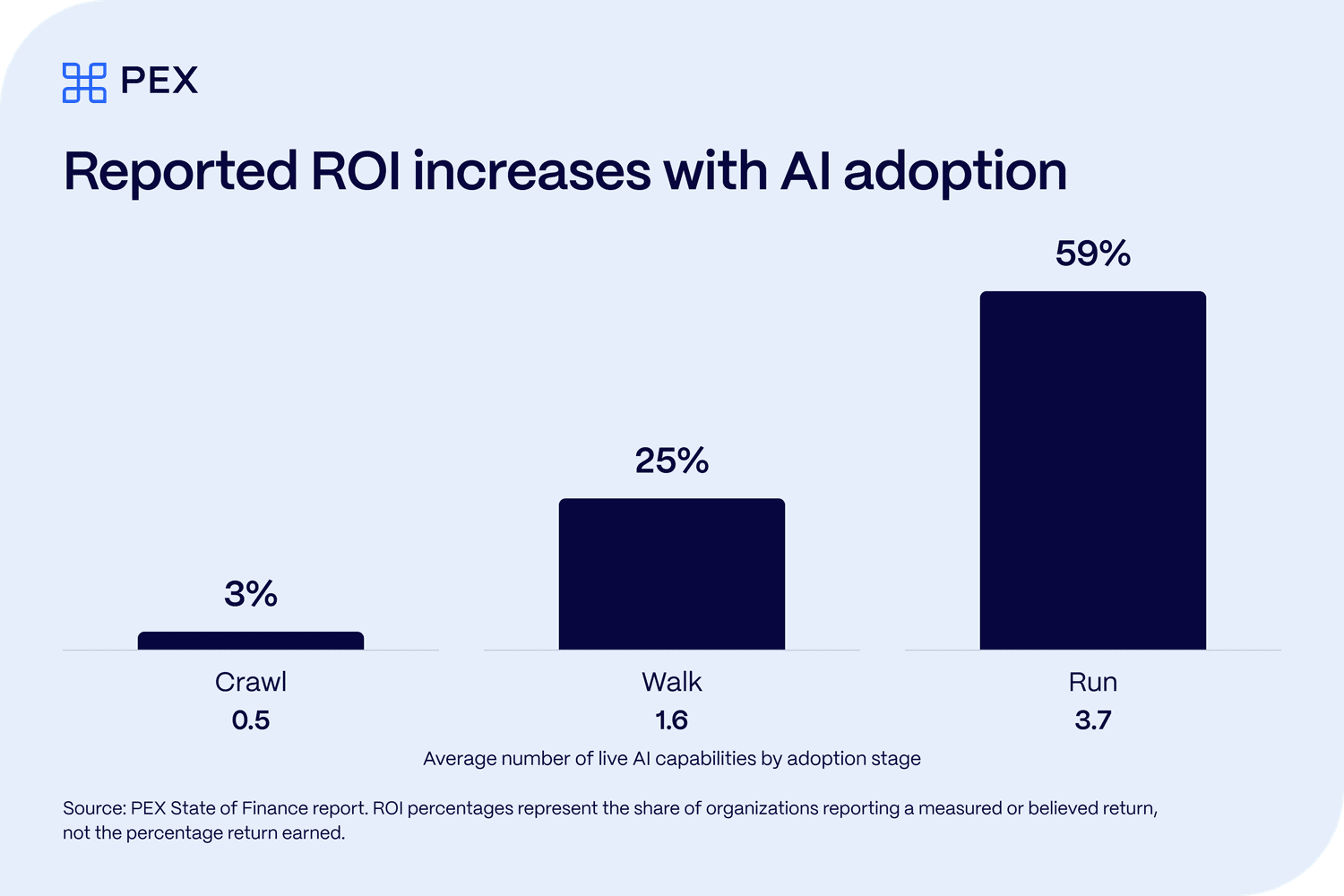
The difference is hard to ignore. Organizations in the run stage are nearly 20 times as likely to report ROI as those that haven’t started. And the benefits aren’t limited to financial returns: 82% of run-stage organizations say AI has cut close time and 82% say it has reduced manual review.
How to extend finance automation beyond your first use case
This is where most finance teams sit today. According to the report, 45% of teams are at the walk stage, and it’s the largest stage in every revenue band above $10 million, peaking at 63% among organizations with $50 million to $250 million in revenue. The report’s advice for these teams is to add a second and third capability, measure the results and expand from there. Once you’ve automated one task, look at where work still slows down. Are employees reentering data, chasing missing information or manually moving transactions between systems? Those are signs your first automation has reached its limit.
Here’s how to find the next opportunity:
- Map the entire workflow. Follow a transaction from purchase through the general ledger, noting each system involved and where employees intervene.
- Identify the biggest bottlenecks. Look for repetitive data entry, missing information, delays and errors that create extra work.
- Prioritize the next connection. Start with the handoff causing the most friction, especially if fixing it would reduce work elsewhere in the process.
- Establish ownership and oversight. Define who handles approvals, exceptions and incomplete transactions.
- Measure the impact. Track processing time, manual interventions and reconciliation effort to see whether the expanded workflow is delivering results.
By addressing one bottleneck at a time, finance teams can build on their initial gains without sacrificing visibility or control.
Four ways to build a connected finance workflow
Once you’ve identified the bottlenecks, the next step is figuring out how to address them. Here are four common problems and the automation capabilities that can help solve them.
1. Incomplete transaction data: Standardize information from the start
If your team spends time tracking down receipts, correcting transaction details or assigning accounting categories, focus on capturing accurate information earlier in the process.
Automated receipt matching and AI-assisted coding can help ensure each transaction has the documentation, accounting category and other details needed for downstream processing. Consistent, structured data reduces the corrections finance teams have to make before transactions reach accounting.
2. Disconnected systems: Reduce manual handoffs
If employees are exporting files, reentering information or checking that records match across platforms, look for opportunities to connect the systems involved.
Integrations between expense management and accounting platforms can move transaction details, receipts and coding information between systems. This reduces duplicate data entry and gives finance teams fewer records to reconcile manually.
3. Too many manual reviews: Automate routine controls
If finance employees spend hours checking transactions against spending policies, consider which controls can be applied before a purchase and which exceptions still require human review.
Spending limits and merchant category restrictions can help prevent unauthorized purchases. Automated rules can also identify missing documentation or other exceptions and route them for follow-up. That allows routine transactions to move forward while employees focus on items that need attention.
4. Limited visibility: Make transaction data easier to use
If your team has to pull information from multiple sources to understand spending, focus on making transaction data available throughout the process.
Real-time transaction visibility can help finance teams monitor budgets, identify unusual activity and address problems before month-end. With fewer gaps in the data, finance leaders also have better information for reporting and forecasting.
How PEX supports connected finance automation in practice
PEX brings these capabilities together across the transaction lifecycle, from spending controls at purchase through documentation, accounting and reporting.
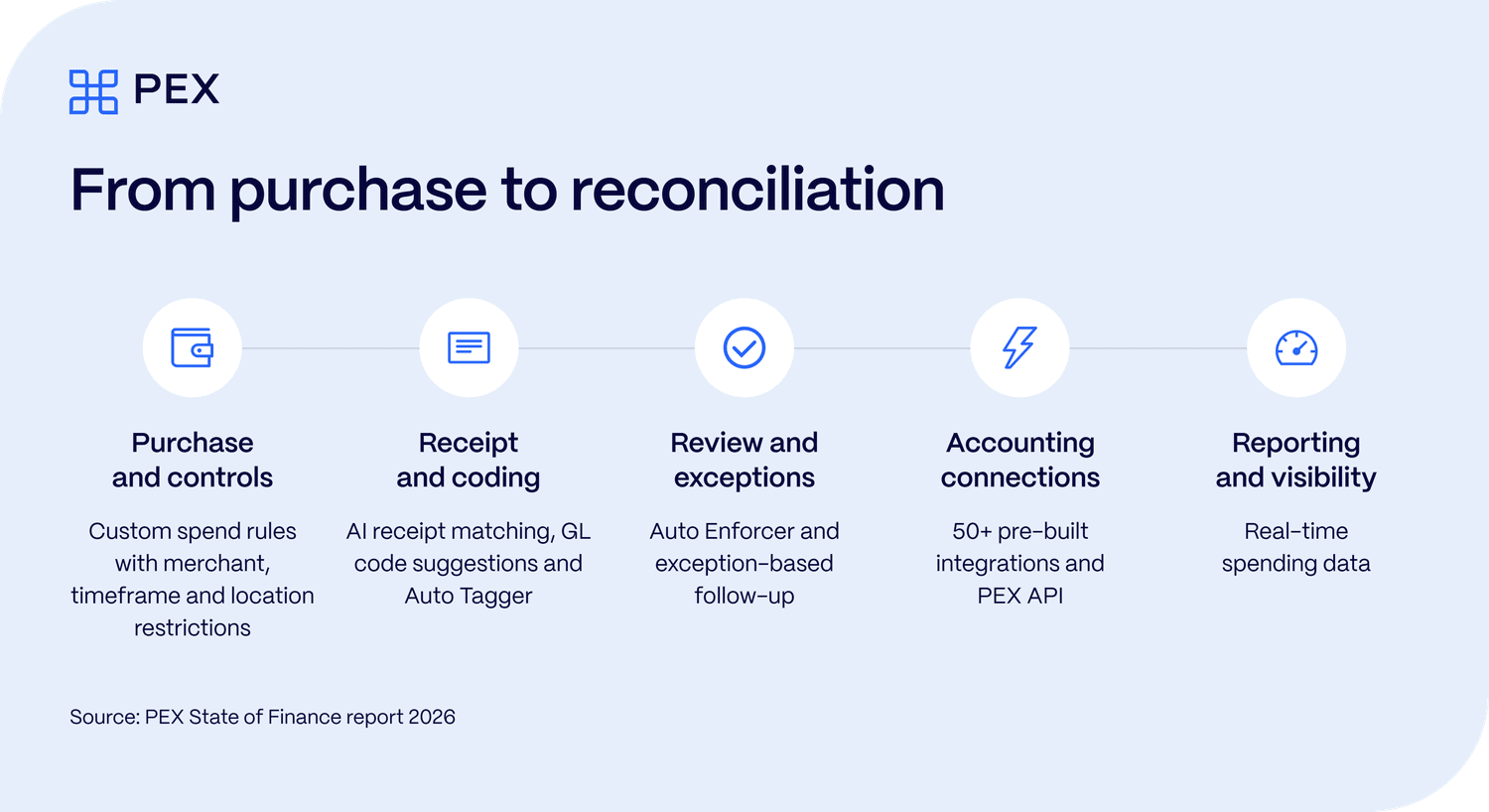
With PEX, finance teams can set spending limits and category restrictions before purchases happen. AI-enabled receipt matching reduces the work of connecting receipts to transactions. AI-powered GL code suggestions help users categorize transactions, while Auto Tagger applies predefined rules. Auto Enforcer helps enforce policy compliance by prompting cardholders to provide missing receipts. The PEX agent can also complete multiple account-management actions from a single request, reducing the manual steps admins take to keep the workflow running.
PEX also connects with expense management systems and accounting platforms, including SAP Concur, Sage Intacct and QuickBooks, to reduce the need to transfer transaction data manually. The PEX API supports additional integration needs, while real-time reporting helps finance teams monitor spending and identify issues throughout the process.
Eastshore Alliance: Connecting expense management and accounting
Eastshore Alliance shows how these connections work in practice. TThe nonprofit youth soccer club uses PEX to manage spending across more than 30 cardholders. Transaction information flows into SAP Concur, where receipts and expense approvals are handled, then approved information moves into QuickBooks.
This connected workflow helps Eastshore Alliance maintain oversight while reducing manual work between systems. The organization saves approximately 10 hours per month on expense management, while coaches no longer have to cover travel expenses out of pocket and wait for reimbursement.
Build on the first win
The greatest value comes when finance teams can reduce manual work without giving up control. Connecting automation across the transaction lifecycle helps teams spend less time on routine tasks and more time managing exceptions and supporting the business.
Most midmarket teams still have that payoff ahead of them. Only 9% of organizations with $10 million to $50 million in revenue and 12% at $50 million to $250 million have reached the run stage. The path there is the same for every team: start with one high-friction problem, prove its value, then expand from there.
PEX’s 2026 State of Finance report shows how organizations at different stages of AI adoption are putting automation to work and where they’re seeing returns. Download the report to benchmark your progress and identify your next opportunity.



Opinions, advice, services, or other information or content expressed or contributed here by customers, users, or others, are those of the respective author(s) or contributor(s) and do not necessarily state or reflect those of The Bancorp Bank, N.A. (“Bank”). Bank is not responsible for the accuracy of any content provided by author(s) or contributor(s).