




PEX AI-powered GL coding: Helping finance teams close books faster

Finance teams worldwide are investing in automation and AI from expense management tools to month-end close. In fact, three-quarters of CFOs say their technology budgets will grow this year, with nearly half expecting at least a 10% increase, according to Gartner.
Yet one step in the workflow still relies heavily on manual effort: GL coding.
GL coding needs to be applied to every transaction, sometimes 5 at a time. This requires confirming the correct account, assigning the department, manual review and fixing inconsistencies as purchases get added to the accounting platform. The process repeats thousands of times a year.
Each coded transaction feels small. But when volume rises and headcount stays flat, those minutes compound into meaningful capacity loss.
GL coding itself isn’t the problem. The problem is the time it absorbs across every close cycle, slowing timelines and consuming hours finance teams don’t have.
How small inefficiencies create workflow drag and risk
Manual GL coding doesn’t just consume time. It introduces friction across the entire close process. When transactions are coded manually, issues surface in predictable ways:
- Delayed visibility into spend
Categorization isn’t finalized until after exports are downloaded, reviewed and corrected. That lag makes it harder to automate reconciliation and keep close cycles predictable. - Inconsistent coding across departments
One team codes a merchant one way. Another codes it differently. Reclassification happens during review, increasing oversight and extending reconciliation. - Spreadsheet version-control risk
Data is exported, edited and reuploaded. Each manual touchpoint increases the chance of errors and audit exposure. - Receipt chasing and rework
Late uploads and missing documentation force finance teams to revisit transactions they thought were complete.
Together, these issues create workflow drag, with slower reviews, heavier oversight and close timelines that feel harder to control than they should.
The shift from manual coding to embedded automation
GL coding has traditionally lived inside accounting workflows, not inside the transaction itself.
In many environments, automation stops at transaction capture. Transactions flow into reports, but classification and validation still happen later, during review.
Modern finance tools are rethinking that model. They embed GL coding directly into the flow of spend. Categorization happens earlier. Fewer transactions require manual intervention. Review becomes exception-based instead of transaction-based.
That shift changes the dynamic:
- From reactive to real-time
GL coding happens at the moment of spend instead of waiting for reconciliation. - From transaction-by-transaction review to exception management
Predictable activity is handled automatically. Teams focus attention where judgment is actually needed. - Less spreadsheet cleanup, more structured controls
Categorization logic lives inside the workflow, reducing the need for exports and rework.
AI finance tools extend this further by analyzing new transactions and surfacing likely categorizations for review. But oversight remains with the finance team. The result is fewer repetitive touchpoints and a cleaner path to month-end close.
How PEX Auto Tagger reduces manual GL coding
PEX Auto Tagger embeds GL coding directly into the transaction workflow and allows users to automatically code transactions, eliminating the need to code expenses after the fact.
Rule-based GL coding automation
With PEX AutoTagger, finance teams define their GL code logic in advance. Merchant mappings, department rules and location logic are configured once. As transactions post, GL coding is applied automatically in real time — eliminating spreadsheet exports, manual sorting and repetitive classification work during reconciliation.
PEX customers report saving an average of 2.92 minutes per transaction through rule-based automation. Those savings come from eliminating predictable manual coding.
At scale, those minutes add up. For example, a team processing 13,500 transactions per year would recover approximately 657 hours of capacity, the equivalent of about $35,476 in labor value. This model illustrates how small efficiencies in GL coding translate into measurable operational impact.
“I like that my receipts and notes are all in one place. I also really like the updates, such as Auto Enforcer, and the fact that I can add GL codes as tags.”
— Brenda Ladewig, Senior Property Accountant at Cypressbrook
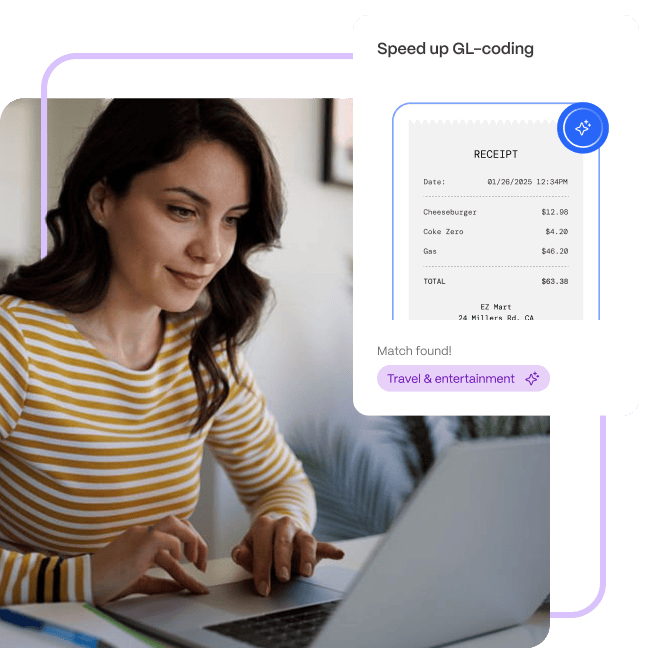
AI-powered GL coding suggestions
For transactions that don’t match an existing rule, PEX leverages AI to review new transactions, scan receipts and invoices and suggest GL codes based on historical tagging behavior. Finance teams confirm or adjust the recommendation, preserving oversight while reducing review time.
Rule-based automation eliminates predictable manual work. AI finance tools reduce time spent evaluating exceptions. Together, these layers change how close cycles are managed.
The operational impact at scale
The result is more than faster coding. It’s a shift in how finance teams manage close cycles. Instead of reviewing every transaction, teams focus on exceptions. Reclassifications decline because data is cleaner earlier in the process.
That means:
- Faster and more predictable month-end close
- Stronger consistency and audit readiness
- The ability to scale transaction volume without adding headcount
GL coding becomes embedded infrastructure, not a recurring manual burden.
Make GL coding invisible
When GL coding is embedded into the transaction workflow, close cycles become faster and more predictable. Finance teams spend less time reviewing routine transactions and more time on analysis, planning and oversight.
PEX Auto Tagger operationalizes that shift inside the transaction workflow. Rule-based automation handles repeatable coding. AI-powered suggestions reduce exception review. The result is cleaner data earlier in the process and fewer manual touchpoints during reconciliation.
Book a demo to see how PEX can help your organization recover capacity from manual GL coding and scale with confidence.



Opinions, advice, services, or other information or content expressed or contributed here by customers, users, or others, are those of the respective author(s) or contributor(s) and do not necessarily state or reflect those of The Bancorp Bank, N.A. (“Bank”). Bank is not responsible for the accuracy of any content provided by author(s) or contributor(s).