





Corporate cards for growing teams: What matters after your first 10 employees

Corporate cards feel simple when your company is small. One card, a handful of purchases and a quick review at month-end.
That simplicity fades fast once you pass 10 employees. After that point, expense management stops being a policy problem and becomes a systems problem. Corporate cards start influencing how well finance controls spending, maintains visibility and keeps pace with growth. This blog explains what changes after that first growth milestone and what CFOs and accountants should prioritize next.
Why your needs from corporate cards change after your first 10 employees
After your first 10 employees, spending spreads out across the organization. More people book travel, purchase software, pay vendors and cover day-to-day operational costs.
When corporate cards don’t support that shift, finance teams feel the strain. Shared cards create confusion. Receipts arrive late. Visibility drops just as spending volume increases.
At this stage, the change isn’t about different cards. It’s about stronger structure around how corporate cards are issued, controlled and tracked so finance can keep up with growth without adding friction.
What corporate cards need to do for growing teams
Growing teams need corporate cards that actively support control and efficiency.
At this stage, finance relies on corporate cards to:
- Assign clear ownership to every transaction
- Enforce spend rules automatically
- Capture transaction data in real time
- Reduce back-and-forth during reconciliation
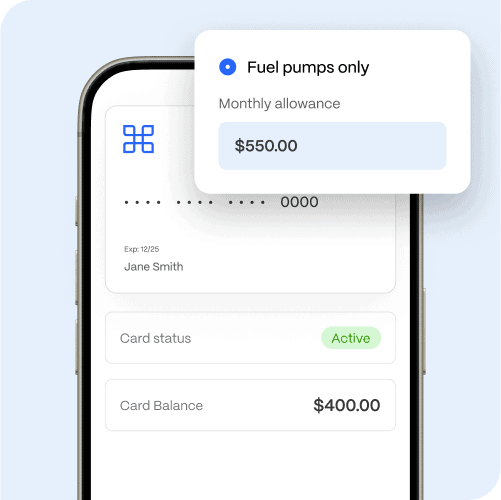
When corporate cards handle these basics well, finance can stay lean while the business scales.
How growing teams should structure corporate cards
One of the most common questions around CFOs is how many corporate cards a growing company should have.
The answer is less about quantity and more about structure.
Corporate cards work best when they align to how work actually happens:
- Employees with regular spend need individual cards
- Vendors and subscriptions benefit from dedicated cards
- Projects often require defined spend boundaries
This structure reduces confusion, limits risk and makes corporate card activity easier to manage as headcount grows.
How corporate cards support different spending patterns as teams grow
As teams scale, spending starts to look different depending on how the organization operates.
For teams that manage programs, events or grant-funded work, spending often needs to be clearly separated to maintain transparency and simplify reporting. Without structure, finance teams spend extra time sorting transactions and preparing for audits.
In project-based environments, spending tends to happen across locations, timelines and vendors. As headcount grows, finance needs clearer ownership of purchases and tighter controls around where and how money is spent to avoid surprises at month-end.
In both cases, corporate cards work best when they align to real spending behavior. Issuing cards by role or purpose, using dedicated cards for vendors or subscriptions and setting clear boundaries around spend all help finance maintain control without slowing teams down.
Corporate cards should support growth, not slow it down
After your first 10 employees, corporate cards directly affect how fast finance can move.
When teams manage cards manually, finance spends too much time chasing receipts, coding transactions and fixing issues after the fact. As spending grows, that work compounds and pulls finance away from higher-value work.
Corporate cards should reduce friction, not add to it.
This is why having flexible card options matters. Platforms like PEX offer different corporate card types that align to how teams actually spend:
- PEX Visa® Prepaid Card for controlled, everyday employee spending
- PEX Disburse Visa® Prepaid Card for paying vendors, program participants or recipients without checks
- Virtual cards for vendors, subscriptions and one-time purchases
Matching the right card to the right use case helps finance:
- Maintain clear ownership of spending
- Apply guardrails without manual oversight
- See transactions in real time
- Reduce reconciliation work at month-end
According to a commissioned study conducted by Forrester Consulting on behalf of PEX, organizations that paired corporate cards with automation and real-time controls saved 8,700 hours annually by Year 3 and generated $788,000 in productivity gains over three years as they scaled.
For growing teams, that impact adds up fast. Corporate cards that scale well give employees the freedom to spend responsibly and give finance the clarity it needs to lead with confidence.
Book a personalized demo to walk through how PEX supports growing finance teams with real-time visibility, built-in controls and less manual work as headcount increases.



Opinions, advice, services, or other information or content expressed or contributed here by customers, users, or others, are those of the respective author(s) or contributor(s) and do not necessarily state or reflect those of The Bancorp Bank, N.A. (“Bank”). Bank is not responsible for the accuracy of any content provided by author(s) or contributor(s).