





A step-by-step guide to getting buy-in on financial priorities

During the PEX CFO Roundtable, one of our attendees asked the following question:
“I joined a 102-year-old company as their first degree accountant, and I’m struggling to change mindsets around outdated financial processes. How do I get non-financial people to understand why certain changes are necessary?”
This question clearly illustrates the challenges CFOs struggle with today. The C-suite and the board expect them to play a central role in shaping the strategic direction of the organization.
Respondents in Pigment’s The State of FP&A 2024 report say that “they feel pressure to evolve their role beyond perceived number crunching and advise on business decisions ahead of time.“
Other parts of the organization are sending an opposing message. Almost 90% of respondents in Microsoft’s 2023 Future of Finance Trends report say they are under pressure from other departments to “stay in their lane,” in terms of traditional finance work.
Today’s CFOs need to navigate these two opposing viewpoints – AND forge a path forward towards organizational buy-in on financial priorities.
How CFOs and organizations got to this point
Finance departments are typically the most conservative part of the organization, with a “we’ve always done it this way” mentality. The rest of the org has a perception of CFOs too, and it’s typically that of a bean-counter – mainly a reactive role in the org.
In addition, CFOs have dealt with myriad manual processes, including things like receipt chasing, spreadsheet reporting and reconciliation. Over three-quarters of reporting CFOs in Datarails’ CFO: No Way Home report that “they have the most manual labor-intensive role on a day-to-day basis compared to other C-level executives.”
All that manual work leaves no time or space to offer strategic guidance. Jeanne Dion, Vice President of the Value Experience Group at SAP Concur, shared her experience trying to make space for strategic work:
“Half the challenge is freeing yourself up to be able to do that. That means pulling yourself out of the weeds, wherever possible, so you can be more strategic.”
And coupling that with the current accounting talent shortage means that CFOs couldn’t offload manual work – even if they wanted to.
What CFOs can do to change the narrative
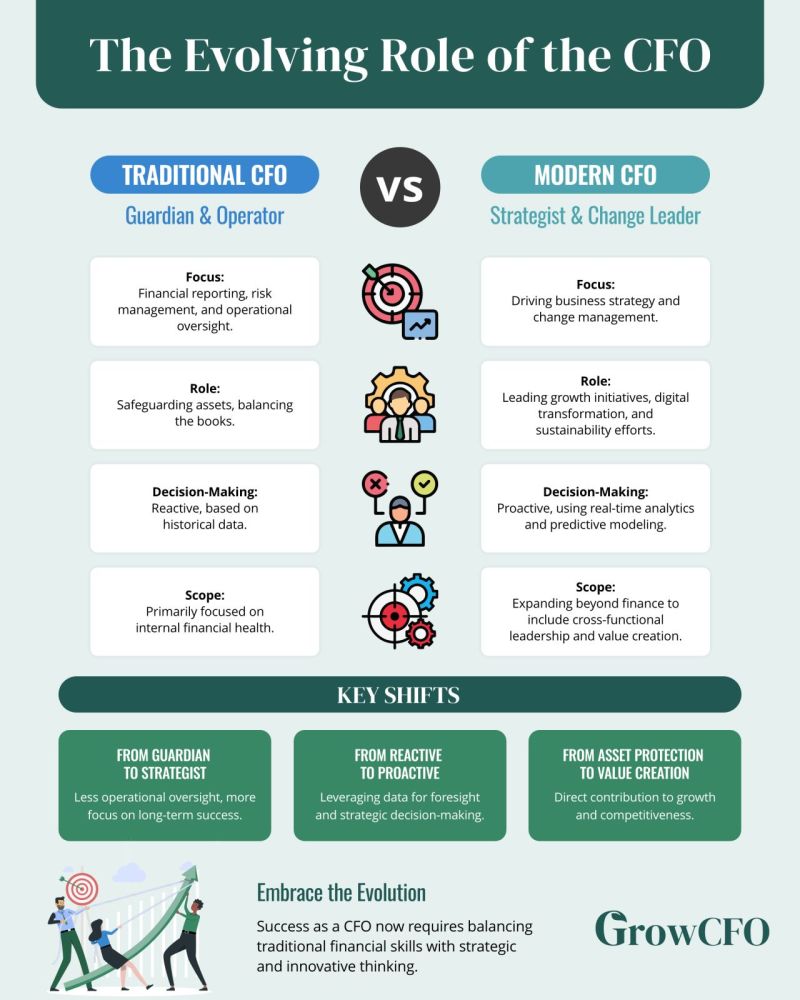
(Source: https://www.linkedin.com/in/dan-wells-growcfo/, LinkedIn, 02/14/2025)
In order to transition from an operational head to a strategic leader, and bring the organization along with them, CFOs will have to go through a metamorphosis. Dan Wells, founder and CEO of GrowCFO says “Today’s CFO spends less time on operational oversight and more on shaping the future of the business”. Here are three critical steps to the process:
Get your financial operations in order
The first step to CFO transformation is to evaluate the state of the finance team’s operations, by asking questions like:
- How are expense management, reconciliation and reporting happening today?
- Which manual processes cause the biggest time deficits?
- Where can we add in automation and AI to improve efficiency and reduce errors?
It’s critical that CFOs eliminate as much manual work as possible with automated processes and systems that have high accuracy rates. The solutions can range from developers building in-house automations and/or AI agents, to external platforms that do the heavy lifting.
And it’s not just about time-savings and reduced errors. CFOs need to ensure that no matter the process or system they choose, they have access to a centralized view of real-time financial data. A real-time financial dashboard will serve as the basis for any strategic recommendations they make.
Expense management platforms offer many of the functions CFOs need, like real-time receipt capture, automated workflows and spend controls. Those that integrate with accounting tools bring all financial data together under one roof.
Learn what stakeholders value
While they are evaluating financial operations, CFOs should also reach out to key stakeholders in the organization. This should be a fact-finding mission first – before getting into presentation mode.
In order to drive the necessary financial changes in the organization, stakeholders need to feel connected to the mission. CFOs can drive that connection by tying what stakeholders value to financial goals and priorities. “It’s all about framing the conversation in terms of their goals and priorities,” said Jeanne Dion, Vice President of the Value Experience Group at SAP Concur.
Let’s say the CFO meets with the head of technical support and learns that one of their top values is having more time to focus on higher-priority work. Today, that higher-priority work is getting pushed aside due to endless technical inquiries. The CFO can take that information and frame discussions about leveraging budget for process changes that free up time.
Write a new story about the office of the CFO
Armed with a more efficient financial stack and an understanding of what stakeholders value most, CFOs can start to create their own narrative. They should focus on sharing what the finance team does and how it provides value to the organization as a whole.
To create a new narrative, let’s say our example CFO works together with the CEO to create a joint presentation at an upcoming quarterly meeting. They plan to discuss how to grow the company to $60M in annual revenue over the course of 5 years.
The CEO leads the “why” part of the presentation and the CFO leads the “how.” Using data visualization, he explains the forecast that takes the company from $5M to $60M in annual revenue in the next 5 years. Then he talks through all the factors that will drive this growth – investment capital, increased sales, and the participation of the entire company. He shares specific ways that each employee can contribute to the growth trajectory.
The CFO has effectively flipped the script. He’s demonstrated how he can be a proactive partner in moving the organization forward.
Getting financial buy-in with a roadshow
This joint CEO/CFO presentation didn’t happen overnight. It’s the result of countless conversations throughout the organization to inform and influence stakeholders – a roadshow of sorts. Oren Geshuri, Senior Manager at Deloitte, explained the roadshow concept to our CFO roundtable participants:
“Meet with other departments and explain what finance does, how it impacts their work, and how their actions affect cash flow and overall financial health. Use data to tell your story. Show them, for example, how making small changes can lead to big improvements.”
CFOs need a few key components to ensure that a roadshow will successfully achieve buy-in.
One centralized source of real-time financial data
CFOs can always set meetings, deliver presentations to stakeholders and get financial buy-in. But if all of that work is based on incorrect or outdated financial data, changes in spending could actually do more harm than good.
Finance teams need a single source of truth where all financial data lives – that is updated in real-time. Knowing that everything is in one place, and updates are coming in instantaneously, will allow them (and their stakeholders) to trust their own decisions and recommendations.
Expense management tools can ingest transaction data in real time, ensuring CFOs see the most current view of corporate spend. Syncing with accounting platforms further centralizes financial data by marrying real-time transactions to accounting journal entries.
Easy-to-follow expense policies
When changing or implementing new expense policies, it’s critical that CFOs make it easy for the whole company to follow those policies. If finance wants teams to upload receipts at the time of purchase, make sure employees can do it on their mobile phone. If they want to limit purchases for specific teams, build in automation rather than putting the burden on employees.
Wherever possible, CFOs should remove manual effort for employees and staff. Expense policies should run on autopilot, so it’s easier for teams to say “yes.”
Expense management platforms frequently leverage automation and AI to make expense policies a no-brainer. Card transactions are instantaneously recorded and matched to receipt images that employees upload via mobile phone. Automation allows CFOs and their teams to create customized levels of approval and block prohibited spending. Employees don’t even have to think about expense policies – the rules are enforced by default.
Strategies to anticipate organizational needs
CFOs and their teams need to demonstrate the shift from reactive to proactive financial management. A big part of being proactive is anticipating the needs of the organization as a whole and individual stakeholders.
A construction company, for example, may be managing anywhere between 40 and 60 projects at a time. While those projects are underway, the organization needs to pay contractors, purchase supplies ahead of time and reimburse employees for travel mileage.
A CFO at this company could show stakeholders that they are monitoring budgets on a real-time basis, allowing them to shift budget dollars as needed. They might shop around for payment methods to both purchase supplies and pay contractors, while giving the org a little wiggle room on payback. These activities show their commitment to meeting organizational goals.
PEX can support your efforts to achieve financial buy-in
Doing the work to achieve financial buy-in shows stakeholders that the CFO is a partner in helping the organization succeed. It’s important to remember that this is a process that takes time. Oren Geshuri, Senior Manager at Deloitte, shared his take at our CFO roundtable:
“Success often comes through incremental change. Start small, build trust, and slowly introduce larger shifts over time.”
Whether you plan to start small or go big, PEX’s expense management platform can help your organization streamline financial operations. By leveraging automation and AI, you can eliminate manual work and focus on the bigger financial picture. Contact us for a customized demo.



Opinions, advice, services, or other information or content expressed or contributed here by customers, users, or others, are those of the respective author(s) or contributor(s) and do not necessarily state or reflect those of The Bancorp Bank, N.A. (“Bank”). Bank is not responsible for the accuracy of any content provided by author(s) or contributor(s).