





Does AI actually save finance teams time? We shared our insights with Capterra

Every accounting and expense management platform says it has AI now. Capterra wanted a real answer, so it went straight to the source: the vendors building these tools. For its new report, “Does AI-Powered Accounting Software Actually Save Time?”, Capterra surveyed 10 leading accounting and finance platforms, including us, about what their AI actually does, how many customers use it and where it still falls short. The findings back up what we hear from our own customers every day: AI saves real time, but only when it stays in its lane and lets people keep the final call.
The short answer: yes, when AI sticks to repetitive work
8 of the 10 vendors Capterra surveyed report that AI now automates more than half of previously manual accounting tasks, mostly in bank reconciliation and invoice processing. Capterra’s broader research backs this up: 89% of AI users report a positive return on their investment, with gains in productivity, fewer errors and faster month-end closes. Even so, the work isn’t done. Capterra found 48% of finance teams still process accounts payable and receivable manually at least part of the time, which is exactly where the next round of automation needs to go.
Where our customers see the biggest wins
We shared our own numbers with Capterra: our customers save 5 hours per employee and 20 hours per finance team member every month by cutting out manual receipt chasing, expense coding and reconciliation. Real-time AI-powered receipt matching and AI-powered GL-coding handle the repetitive work, so finance teams get that time back for higher-value work. Our customer Eastshore Alliance FC saw this firsthand, saving 10 hours a month by automating receipt capture and customer Cypressbrook Multifamily Management cut reconciliation time by 5 hours a month with automated GL coding.
Toffer Grant, PEX co-founder and CEO, put it this way in the report:
Too many vendors bolt AI onto old workflows and call it innovation. We built PEX around a different idea: free teams from repetitive tasks like receipt chasing and reconciliation and create space for insight, for spotting risk, guiding strategy, and building trust with the board. That’s what actually matters: using AI to give teams room to lead.
Toffer Grant, Founder and CEO of PEX
Where AI still needs human oversight and why we built it that way
Capterra’s report groups the 10 vendors into three adoption patterns, based on how far customers lean into AI. We land in what Capterra calls the “guarded assistant” group: AI speeds up the repetitive work and a person makes the final call on anything that carries risk. Across all 10 vendors, multi-entity and multi-currency reconciliation and AI-written report narratives are the two tasks providers trust AI with least, each flagged by four of them. That matches our own approach. We keep people in charge of the decisions that carry risk, by design, not as an afterthought.
AI should support finance teams, not replace them
Accounting departments are stretched thin. Capterra’s research found 73% of organizations struggled to retain accounting staff over the past two years and 43% cited a shortage of qualified candidates, with financial analysts, specialized accountants and staff accountants among the hardest roles to fill. That’s the backdrop for why we build AI features that free up the staff finance teams already have, instead of replacing them.
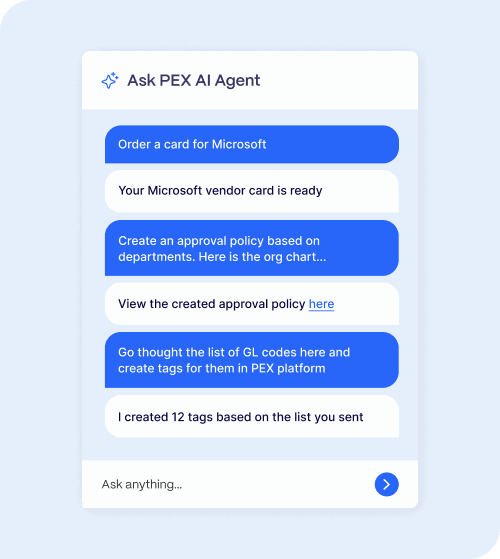
Our PEX AI Agent is a live example: a built-in assistant in the PEX Dashboard that walks admins through daily tasks like creating approval policies, ordering cards, inviting team members and identifying missing receipts, and answers questions about account activity as they come up. It points to where this is all headed: AI that handles the daily lookups and busywork, receipt chasing and coding included, so finance teams get room for the analysis and judgment work that actually needs human oversight.
Usage climbs when the economy gets shaky
We’re also one of the vendors in the report that sees AI usage climb during economic uncertainty and it’s not simply because the technology got better on its own. When markets get volatile, our customers lean harder on the budgets and spend rules they’ve already set and on real-time visibility into every transaction, so they can catch overspending before it compounds instead of finding it at month-end. That gives finance leaders a tighter view of cost and variance. Capterra’s broader trends research shows the same instinct across the industry: finance teams point to predictive cash flow analytics and risk management as some of the most valuable capabilities when conditions get tough.
What’s next: querying your books like you’d ask a colleague
Natural language querying is the top development priority across the vendors Capterra surveyed, named by six of 10, PEX included. We’ve built toward open standards, including a model context protocol (MCP) server and open APIs, so admins can already query live PEX data directly from AI assistants such as Claude, without giving up the security controls they rely on today. In practice, that means asking things like “show me all unreviewed transactions this month,” “which transactions are over $500 and missing receipts” or “check the business balance across both accounts,” and get an answer without opening the dashboard.
Read the full report
Capterra’s report covers all 10 vendors surveyed, including how buyers are purchasing AI today, where the industry is placing its development bets and how much finance teams still check AI’s work by hand. Read the full Capterra report.



Opinions, advice, services, or other information or content expressed or contributed here by customers, users, or others, are those of the respective author(s) or contributor(s) and do not necessarily state or reflect those of The Bancorp Bank, N.A. (“Bank”). Bank is not responsible for the accuracy of any content provided by author(s) or contributor(s).